
A reality Sahel families already know.
In Niger and across the Sahel, thousands of children face the risk of abduction, disappearance or getting lost every day. This is not a headline or an abstraction: it is daily life for entire families.
A security and social context under strain
The Sahel is going through a period marked by insecurity, population displacement and heavy socio-economic pressure. In that context, keeping an eye on a child every day becomes harder for parents who work, travel, or live far from the school.
The walk to school, crowded markets, fast-growing neighbourhoods: ordinary situations where a child can wander off in seconds. Most of the time it ends well. The worry, though, never stops.
Families have few tools for this. Existing location solutions are designed for other markets: they assume a recent smartphone, a stable connection, a subscription priced in euros, and support that does not speak the local language.
What is missing today
Tools built for the ground
2G/3G networks, power cuts, entry-level phones: the local technical reality is not the one existing solutions were designed for.
An affordable price
A subscription billed in foreign currency, payable only by bank card, effectively shuts out most families in the region.
Local roots
Support you can actually reach, in the right language, that understands the context: that is the difference between a product used and a product abandoned.
The scope of our work
+500
families already interested
in the Niamey pilot
1
pilot city
Niamey, Niger
4
target countries
Niger, Mali, Burkina Faso, Nigeria
Des milliers
of children to protect
every day across the region
Detailed context figures and their sources will be published here as the pilot progresses.
A real problem calls for a concrete answer
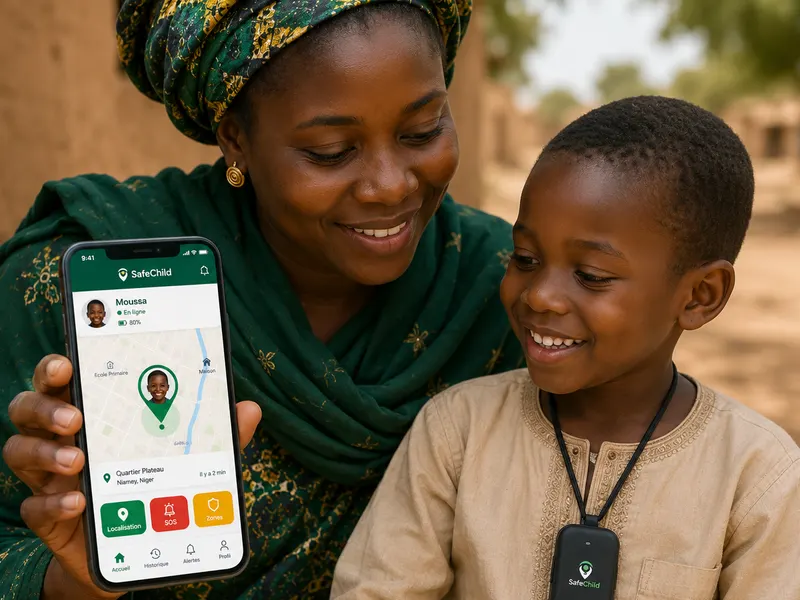
SafeChild does not aim to solve everything. Our answer is precise: give parents a simple, reliable and affordable way to know where their child is, and to be warned when something is out of the ordinary.
Explore our solution